
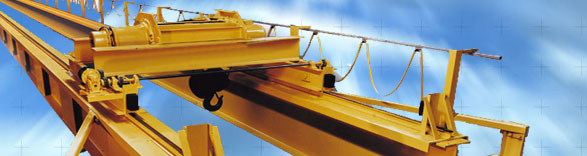
STANMEK INGENIEURS SPECIAL PURPOSE CRANES
Cranes specifically engineered for: High duty cycles, continuo loads, high temperatures, hot metal handling, catic & corrosive environments
At STANMEK, our engineers take great pride in their ability to provide ctomers with the crane that best meets the requirements of their application. Many times it takes only a small modification of a standard configuration to make a great improvement in the crane's performance for a particular job. Other times, it has proven best to ctom design the complete handling system to achieve the desired results.
Our engineers have designed hundreds of ctom cranes and the one thing all of these ctom installations have in common is a satisfied ctomer. Your application may benefit from a ctom designed crane from STANMEK Indtries
High Duty Cycles
Class "D" Cranes provide a much longer operational life, lower maintenance costs and greatly reduced down time. The initial expense of upgrading from a Class "C" to a Class "D" crane is quickly recouped.
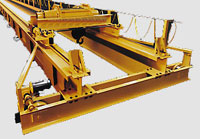
CMAA sets the standards
The Crane Manufacturer Association of America (CMAA) has issued over 150 pages of specifications detailing how to design and build cranes of differing classes. An extensive list of more than 50 crane components (wheels, bearings, motors, axles, " contactors, etc.) are "upsized" for each successive crane class. Crane duty classifications are strictly regulated by the CMAA and mt be documented by engineering calculations. The perception that crane classifications are merely a marketing gimmick is false.
What is a "Heavy Duty" application?
Class "C" applications can be accommodated with either a Class "C" or a Class "D" crane. Buying a Class "D" crane for a class "C" application will extend the crane's operational life (lasting up to 40 years), result in minimized maintenance, virtually no down time, and will significantly improve margins of safety.
Consider what the CMAA specifications dictate for cranes of equal lifting capacity but different classifications. Class "D" Cranes, as compared to Class "C" cranes, are designed to:
- Make twice as many lifts over their lifetime
- Lift the maximum rated load with 30% greater frequency
Continuo Loads
Overhead lifting systems are ed in virtually every indtry and in an unlimited variety of applications. Often, an "under the hook" device such as a ladle, magnet, spreader beam, counter-balanced C-hook, etc. is required. Such a device has a major impact on the selection of the hoist with regard to safety, performance, reliability, and maintenance, and mt be taken into account by the crane/hoist manufacturer.
A device which will be permanently carried by the hoist (8 or more hours at a time) constitutes a "continuo load" and requires special considerations. All hoists are designed for intermittent loading which means that during normal operation the hook will, at times, be raised & lowered without any load. Doing so allows the mechanical load brake within the hoist gearbox to self lubricate, th, prolonging its life and insuring the safety of the hoist. When the hoist has a permanent load, the mechanical load brake will wear prematurely and fail. This can cae a "trickle down" failure of the secondary braking system on the hoist (the holding brake attached to the motor) which can leave the hoist with no brakes at all!
There are a number of solutions offered by hoist manufacturers which allow hoists to operate under continuo loads without any threat to the braking systems. Each solution varies a bit on price, lifting speed(s) & control, however, they all eliminate the mechanical load brake within the hoist gearbox. Among the more common solutions:
- A Flux Vector inverter system. This approach is ually the most costly but delivers the highest level of speed control & spotting of loads. A secondary benefit in very high duty cycle applications is prolonged motor life.
- A wound rotor motor with eddy current braking. This approach is less costly as compared to the Flux Vector system, however, it creates a "stepped" speed control on the hoist (typically 5 steps) with the speeds affected by the load on the hook.
- Two heavy duty motor brakes with a timer for sequential control of the brakes. This approach may be the least costly and provides single or dual speed control of the hoist. Lifting speeds are not affected by the load on the hook, however, variable speed is not available.
- Regenerative braking systems. This approach is typically found in some smaller (3 tons or less) capacity hoists as a standard design by some manufacturers. This system offers similar advantages as the dual heavy duty motor brakes but is limited in availability.
High Temperatures
Some cranes are forced to work in very hot areas, such as foundries or heat treating plants. A few important "upgrades" can eliminate most maintenance problems and add 10 years to the life of a crane.
What is "Hot"?
The important consideration is not the temperature at the source of heat, but rather the temperature of the air immediately surrounding the crane components, such as the hoist, bridge motors, control panels, and electrification system. A careful analysis is required to determine which parts of the crane will operate in prolonged periods of high temperatures. A standard crane will operate without problem up to 95 degrees Fahrenheit, or in a typical factory, not air-conditioned and subject to normal summer temperatures.
Electrical Problems
High air temperatures cause electrical components and motors to fail much quicker. This is because heat is a by-product of electrical current. Under cooler operating conditions, this heat is quickly dissipated, but high ambient temperatures slow down heat dissipation, causing major maintenance problems.
Oil Breakdown
High operating temperatures and poor heat dissipation cause the oil on a crane to break down prematurely, requiring frequent oil changes or reducing the life of gears and drives.
Hot Metal Handling
Cranes carrying hot metal have many additional safety considerations, and code-mandated requirements.
If your crane is carrying hot metal, it may be subject to additional requirements beyond those laid out in CMAA (Crane Manufacturers Association of America), OSHA, and NEC (National Electrical Code) specifications. The Foundryman's Code outlines additional provisions for hot metal hoists and trolleys. A customer, in conjunction with their safety committee, insurance company, and local regulators, must decide if a Foundryman's hot metal hoist is required.

A Hot Metal Hoist and Trolley include:
- 8:1 safety factor on the hoist wire rope; 5:1 safety factor is standard. This allows for some "loss of strength" due to the heat. This often requires a special hoist drum to accommodate larger diameter wire rope, or down rating the capacity of a standard hoist (a 15 Ton hoist rated at 10 Tons).
- A power circuit upper limit switch, which cuts all power to the hoist when the hook is in the fully raised position. All hoists have an upper limit switch, but most hoists have only a control circuit upper limit switch, which triggers a control relay which in turn stops the upward travel of the hoist. A power circuit limit switch physically opens a disconnect switch, which actually breaks the circuit. When handling hot metal, it is critical to stop the hook block before it hits the hoist body. Such a collision could cause the hot metal to splash out of the ladle. A standard control circuit limit switch could (in theory) fail to work if the relays become defective, but a power circuit limit switch is nearly foolproof.
- When the hook is in its lowest position (at the floor), there must be Three wraps of wire rope still on the drum (two wraps is the standard).
- Trolleys must be fitted with drop lugs, to hold the trolley on the cross girder in case of axle failure. Standard cranes require only the end trucks to have drop lugs.
- A warning device (either a bell, horn, siren, or flashing light) is required to be activated whenever the crane is in motion.
- All "suspension bolts" (bolts that hold the hoist to the trolley) that are in tension require an external locking device, such as cotter pins, rather than lock washers or double nuts.
Catic & Corrosive Environments
A crane specially designed for caustic environments will last decades longer than a standard crane, and will have dramatically less maintenance and down time.
Some cranes must operate in caustic and corrosive environments such as plating lines, galvanizing facilities, or other open tank chemical processes. In these situations, a standard crane will work -for a while. Maintenance is very high, and crane life short.
Corrosion and Rust Problems
Standard steel components rust and break down when exposed to caustic fumes and liquids. By either substituting chemical-resistant materials for standard steel or applying protective coatings to the crane, the corrosive effects of the caustic agents can be minimized.
- Standard wire rope can be replaced with stainless steel wire rope. This is very desirable if a) the wire rope comes in direct contact with the chemicals, b) you have a history of worn or frayed wire rope.
- Zinc plating the load chain of electric chain hoists has similar benefits as stainless steel wire rope.
- Zinc plating the hook block and hook provides a great deal of protection, especially when the hook and hook block are splashed or submerged into the caustic liquids.
- Track type bridge electrification can be improved. The system can use galvanized or stainless steel track, to prevent rust spots. If rust occurs, the cable trolleys will stick or jam and, in turn, break the cables. The trolleys themselves can be stainless steel cable trolleys or equipped with non-rusting nylon wheels. Standard bridge electrification systems tend to need a great deal of maintenance in a caustic environment.
- Looped wire festooned bridge electrification systems can include stainless steel suspension cable and non-corroding plastic cable trolleys.
- Galvanized solid bar runway electrification can be provided to prevent corrosion, or a stainless-steel covered bar can be used.
- All steel parts that can't be otherwise protected or replaced can be coated with an anti-corrosive epoxy paint. Over time, caustic liquids and fumes will eat through standard enamel paint and start to attack the crane's steel structure. There are over 100 choices of epoxy finishes. By providing the chemical composition of your application, we can custom select the proper Sherwin Williams epoxy coating.
- Steel hoist sheaves can be replaced with high technology, extremely high strength non-rusting polymer sheaves. If the lower hook block is splashed or submerged, this is strongly recommended. Rust or pitting on sheaves greatly reduces wire rope life, and epoxy coating tends to be worn away by the constant rubbing of the wire rope. This material is found in many aerospace products.